 Sylvia Tiryaki attended an international conference aiming to evaluate the EU-Turkey relations and the Turkish foreign policy. The event entitled “The Spanish Presidency: Expectations from Spain and Turkey” took place in Barcelona and was organized jointly by the Barcelona Centre for International Affairs (CIDOB), the Turkish Economic and Social Studies Foundation (TESEV) and the Friedrich Ebert Stiftung (FES). Sylvia Tiryaki participated as a speaker in the third Panel entitled “The Spanish Presidency: Expectations from Spain and Turkey”.
Spain and Turkey during the Spanish EU Presidency
Iran Driven by the Spirit

A Forgotten Promise: Ending the Isolation of Turkish Cypriots
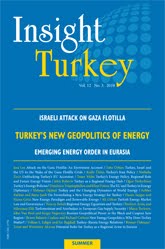
Sylvia Tiryaki and Mensur Akgün wrote an article about the isolation of the Turkish Cypriots. The analysis is available in Insight Turkey, Vol. 12, No. 1/2010. You can read the online version here.
Abstract
Despite repeated calls and promises, Turkish Cypriots live in economic, political and humanitarian isolation. This paper tries to address one aspect of it and elaborates on the legal basis of these isolationist practices imposed on one side of the island. It challenges the international legal validity of the de facto sanctions. Furthermore, it claims that lifting economic isolation will also serve as a confidence building tool between Greek and Turkish Cypriots as well as between Turkey and the Republic of Cyprus represented by the Greek Cypriots since such an act will lead to Turkey’s reciprocation and the normalization of relations with the Republic of Cyprus. It also argues that neither the UN, nor the EU has ever imposed any sanctions on Turkish Cypriots and the policy of isolation, as such, has only been practiced by the Greek Cypriots and the Greeks.is paper intends to clarify the distinction between sanctions and non-recognition. It also highlights the promises made by the EU to the Turkish Cypriots, in particular, the one made on April 26, 2004, when the Council of the EU proclaimed its commitment to end the isolation of the Turkish Cypriot community.
Finding Common Grounds: Rediscovering the Common Narrative of Turkey and Europe

“Finding Common Grounds: Rediscovering the Common Narrative of Turkey and Europe” is the result of the combined efforts of 9 authors who came together to discuss the possible ways forward for Turkey’s EU accession process. As an indication of the content of the book, the authors are likened to “a very atypical group of passengers who found themselves in the same carriage of a train that was speeding towards a point where the track might end. Some of them were searching for a way to stop the train and bring it back to a junction from where they could travel more safely to the desired destination. Others were convinced that there was no way to stop it and they were rather trying to see how to build a new track so that the train could carry on”. Published in 2009 with support from the German Marshall Fund, Friedrich Ebert Stiftung in Bratislava as well as the Open Society Foundation in Bratislava and published by the Research Center of the Slovak Foreign Policy Association, this book has positively contributed to the discourse regarding Turkey’s EU accession since that time. An electronic copy (in English) of the book can be accessed here.
The Following is an Excerpt from the Book Detailing the Chapter’s Contents
“The collection starts with contribution of Hurriyet Daily News
editor-in-chief David Judson, who in his essay looks on what media
can and cannot do in breaking the obvious communication divide
between the EU and Turkey. Then we follow with four articles looking at EU decision-making vis-à-vis Turkey. Adam Szymański writes about the Eu’s fears vis-à-vis Turkish membership and suggests some policies the EU had better employ now. David Král looks at what could be expected from the Czech EU presidency and Deniz Bingol Mcdonald and Peter Balazs analyze the roles of conditionality and public opinion in enlargement. Ceren Ak, Sylvia Tiryaki and Mensur Akgün evaluate the union’s approach after last year’s evaluation report. We close the volume by another reflection by Lucia Najslova– an essay on “talking Turkey” in Slovakia or what it takes to mainstream a seemingly marginal topic.”
The Sixth Bosphorus Conference

Sylvia Tiryaki participated in the sixth Bosphorus Conference, which was held in Istanbul and a theme of which was: “Turkey and the EU: Regaining Momentum“. If you are interested in reading the key conclusions from the conference, click here. The event was organized jointly by the British Council, Delegation of the European Commission to Turkey and the Turkish Economic and Social Studies Foundation.
Slovak Who Makes Peace in Cyprus
Slovak daily Hospodárske noviny interviewed Sylvia Tiryaki and published an article entitled “Slovak Who Makes Peace in Cyprus” under its regular section Slovak Recipe for Success, i.e. series featuring interviews with successful Slovaks living abroad. If you speak Slovak, check Sylvia Tiryaki’s recipe here. If you are interested in English version of the interview, continue reading below.

HN Interview in English
Sylvia Tiryaki. Our expert in international relations helped the former Secretary General of the UN – Kofi Annan – in his search for a peaceful solution.
They were unknown, when they were leaving their homes and became top experts abroad. In our series Slovak Recipe for Success, we tell you stories about successful Slovaks.
She belongs to the very few Slovaks, who have found their new home in Istanbul, Turkey – a city of 17 million people, that connects Europe and Asia. After eight years in the city on Bosphorus, she thinks more in Turkish than in Slovak. As a young Slovak and a mom of a little boy she has become very successful in what she is doing. Such success is not very common in Turkey – she got to the very top of the Turkish political science. Moreover, together with her colleagues she established her own NGO, which ranks among the most respected ones in the whole Istanbul. “I actively try to help out with the search for a solution of the long-lasting conflict between the Turkish Cypriots and the Greek Cypriots,” says Sylvia Tiryaki, who gives lectures on international law at the Istanbul Kultur University, is a columnist in one of the most read daily newspaper Turkish Daily News and organizes conferences with high level representatives from the member states of the European Union.
Tiryaki made a legal analysis of the peace plan proposed by the former UN Secretary General Kofi Annan. Some parts of her analysis appeared in the Annan’s blueprint of the peaceful solution, which was voted on in the Cypriot referenda.
Happiness behind borders
Ever since her student years, Sylvia Tiryaki had a feeling that she would find happiness abroad. “I have traveled around the world. I have spent half a year in Australia and in other countries, too.” Why Turkey then? “Originally, I came to Istanbul for two days only. However, I met my husband and as you can see, I have been here for eight years already,“ laughs our amiable Slovak.
Nowadays, Tiryaki is one of the distinguished Turkish experts in international relations. Since 2003, she has worked in the Turkish Economic and Social Studies Foundation. She has been a coordinator of all the projects dealing with Cyprus and central and Eastern Europe for five years. “In September, with my colleagues from this foundation, we established Global Political Trends Center. All of our activities are focused on the Turkish foreign policy, especially on the conflicts, that are linked to Turkey or in which Turkey can play a role of coordinator,” says Tiryaki.
Turkey has been one of the main actors in the diplomatic row over the Mediterranean island of Cyprus for more than three decades. It is in this area, where the Slovak political scientist found her sphere of influence. In the diplomatic world, Slovakia has become a skilled agent of the peaceful talks between the Turkish Cypriots and the Greek Cypriots. Some of the negotiations were organized by our embassy in Nicosia.
The world is aware of our activities and respects them. “The peaceful talks are conducted under the auspices of the United Nations, but our efforts are surely being noted and appreciated in Turkey, as well,” confirms Tiryaki.
A piece of Slovakia in Istanbul
While there are not so many Slovaks living in Turkey, i.e. a couple of dozens at most, they meet on regular basis and try to help each other. “What creates a good bit of Slovakia here in Istanbul? Most probably it is us, who have a part of our heart at home in Slovakia and the other part here in Turkey. What makes me really happy is that our university signed an Erasmus agreement on exchange of students with the Comenius University in Bratislava. This is already the fourth year for us to have Slovak students over – three to four students every semester. They usually study Turkish foreign policy at the Department of International Relations,” adds Tiryaki.
Slovakia is known in Turkey also thanks to Alexander Dubček, who served as a Czechoslovak ambassador there between the 60ties and 70ties. “I was very pleased when they named a park in Turkey after him,” says Sylvia Tiryaki.
When Dubček came to Turkey at the end of the year 1969, the country welcomed him with an enormous interest. “On his way from the airport to embassy, he was literally being haunted by the paparazzi,” says the current Slovak ambassador to Turkey, Vladimír Jakabčin. It is the bust of Alexander Dubček, that welcomes all the visitors at the entrance to our embassy in Ankara.
A Slovak-Turkish expert in international relations, Sylvia Tiryaki, for HN: There is hard work and many compromises behind everything
Could you tell us your recipe for success?
I do not really have a special recipe for success and I actually do not think there is something that could work for everyone. I know one thing for sure though – a miracle that would just bring you somewhere does not exist. Everything is a consequence of your activities or of how you set up your life. There is only hard work, discipline and many compromises behind everything. There is no shortcut to success.
Why did you decide to go to Turkey particularly?
When me and my husband got married, a question on whether it would be better and more convenient for our family to live in Turkey or in Slovakia arised. In case neither Turkey nor Slovakia would work, our third alternative was Australia. Our final decision was Istanbul. It would be much harder for my husband, who is a Turkish plastic surgeon, to settle down in Slovakia than for me to settle down in Turkey.
What helps you the most in Istanbul?
I find it very important that I have a great support from my family. I was really lucky in this – I have an awesome husband indeed and a great son. My son Teodor is only five years old, yet he is involved in everything that is going on in our household. If he were not like this, I would not be able to be so active professionally.
Was it difficult for a Slovak lady to become successful in a country with a rather Muslim population?
Turkey is a huge and a great country with a giant potential. The native people somehow have it in them naturally that when they look at people around them, they do not see foreigners in them. The important thing is what you do. The value of your work is more important than anything else. That is why a notion “foreigner” almost does not exist here.
Why?
Most probably, the roots are to be found in the history of the Ottoman Empire, since Turkey could be considered as its heir. The Ottoman Empire opted for implementing various elements from foreigners and foreign cultures instead of converting these elements according to their likeness. Hence, the foreigners were never forced to abandon their identity and actually it has stayed like that till today.
By Pavel Novotný
U tureckého soudu začal proces, který může skončit zákazem vládní strany | iDNES.cz
Europe-Russia Economic Forum
 Sylvia Tiryaki participated in the Europe-Russia Economic Forum, which was organized by the Eastern Institute and ISPI in Rome under the High Patronage of the President of the Italian Republic and the Patronage of the Italian Ministry of Foreign Affairs.
Discussion of the Cyprus’ Property Issue
“Discussion of the Cyprus’ Property Issue” which took place on September 14, 2007 was organized by the Swedish Consulate General and TESEV. Sylvia Tiryaki participated in the one-day event and presented the main pillars of the latest TESEV Project on Cyprus. The conference ended with concluding remarks by Mensur Akgün and Sylvia Tiryaki.
The Turks Do Not Want to Hear about the EU at All Now