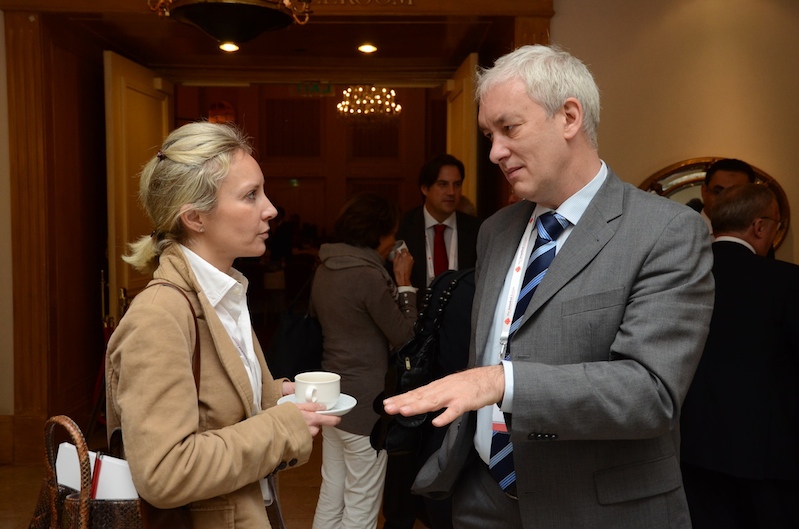
Dr. Tiryaki together with Ambassador Yalim Eralp presented respective dinner speeches at the conference series “International Human Security”, under the auspices of Prof. Dr. Madeleine Atkins, Vice-Chancellor of Coventry University. The event was hosted by Kadir Has University, Akdeniz University and Trakya University in Istanbul on 27-28 October 2011.
The purpose of the conference series is to propose people oriented solutions to problems such as poverty, conflict and disaster and to create a scientific forum in order to discuss these topics in the Turkish academic community. Dr. Tiryaki’s speech is available below.
—
Good evening.
It goes without saying that I feel privileged to able to address this distinguished audience of the human security experts.
Let me begin by thanking the organizers for inviting me and giving me the great opportunity to be here today with you at the Gala Dinner of this highly relevant and timely conference.
It may be cliché – since all “dinner speakers” do the same – yet I would like to acknowledge that it is an awkward position to be in between you and your dinner.
So, let’s keep it short. Yet this presents us with a tough task: speaking briefly about a topic so wide and diverse as human security.
***
We know that even though human security gains increasing attention nowadays, the concept per se is not new at all.
In fact, Thomas Hobbes based his main argument for his social contract theory exactly on the lack of human security in the state of nature. Reflecting the political and social reality of his own times, he called for a political covenant and institution of sovereignty in order to remove human insecurity caused by a natural inclination of all men to violent conflict. In our modern terminology, he was calling upon a sovereign to ensure freedom from fear.
Hobbes’ famous definition of the state of nature as “solitary, poor, nasty, brutish and short” has its antidote in a powerful sovereign who secures peace and thus decreases threats to human security. In return, this sovereign requires full obedience from the public, which has no right to resist political authority.
As Hobbes wrote in Leviathan, by giving up one’s right of governing oneself to the sovereign (be it a single man or an assembly), one has no right to complain of injury from his sovereign, as that would be like someone complaining to himself about doing injury to himself, so to speak.
However, by suggesting the total identification with the sovereign, Hobbes failed to account for the protection of the individual from a political tyrant.
That this was indeed Hobbes’ greatest philosophical failure became apparent not only during the late 1980’s and early 90’s that witnessed the collapse of communists regimes in Central and Eastern Europe, but also recently with the Arab Spring events.
The latter one, i.e. the fight for greater civic and political freedoms in the Maghreb and Middle East, opted for rather a Rousseauist definition of the right to resistance, one that does not exclude violence.
That undoubtedly represents a dilemma vis-a-vis human security, too.
Hence, the question is not only whether to increase human security, and who is responsible for that, but also how to do it.
Obviously, the traditional concept of security is no longer enough. Examples like Rwanda or North Korea have shown that ensuring only territorial security of nation-states through military means does not automatically improve human conditions.
Neither can human security be considered from the national borders perspective anymore. One of the by-products of globalization is a new concept or new global understanding of human security with the individual, a human being, as a point of entry.
The new concept requires a truly holistic approach: combining military security, human rights and development. Or, in other words, safeguarded should be:
security, justice and jobs.
The former UN Secretary-General Kofi Annan expressed it accurately in his March 2005 report, “In Larger Freedom.” “Development, security, and human rights go hand in hand… We will not enjoy development without security, we will not enjoy security without development, and we will not enjoy either without respect for human rights. Unless all these causes are advanced, none will succeed.”
All aspects of this triangle were in fact already envisaged in two of the four freedoms articulated by US President Franklin Delano Roosevelt in January 1941 in his famous “Four Freedoms” speech, namely freedom from want (corresponding with development) and freedom from fear (security).
Here, let me share a small anecdote with you. I just came from a conference that was organized at Hunter College in Roosevelt House in New York. That is the house where the First Lady Eleanor Roosevelt supposedly worked on the first draft of Universal Declaration of Human Rights. The story goes that while four freedoms (speech, religion, fear and want) were very important for her, and they really entered the Preamble of the Declaration, she paid a special attention to another freedom: the right to privacy.
The reason for that was simple: the beautiful Roosevelt House was a wedding gift from the President’s mother Sara and was intimately attached to her own house. Eleanor reportedly complained of her mother-in-law visiting the President and her day and night long.
Be that as it may, a balance must be struck between the freedom from want and freedom from fear. Yet, sometimes it seems difficult for the states to maintain a holistic strategy.
The Freedom House’s “Freedom in the World 2011” annual survey of political rights and civil liberties goes under the title “The Authoritarian Challenge to Democracy,” and it marks an overall decline in freedoms in the past five years.
According to the report “Friend not Foe,” prepared by the Fourth Freedom Forum and the Kroc Institute for International Peace Studies at the University of Notre Dame, the global trend toward using aid and development funds for military purposes has accelerated. It claims that analytical boundaries between security and development are being blurred. It also states that development assistance allocated through the Pentagon has increased in recent years from 3.5 percent in 1998 to approximately 25 percent only ten years later. Aid budgets have increased statistically around the world, but fully two-fifths of the increase since 2002 has gone just to two countries: Iraq and Afghanistan.
The British Department for International Development announced in October 2010 that 35 percent increase in development funding over a four year period but the majority of funds are allocated to Afghanistan and Pakistan.
However, the 2010 report prepared by seven humanitarian agencies in Afghanistan argues that Provincial Reconstruction Teams (military teams established by allied forces in Iraq and Afghanistan to play a direct role in providing humanitarian and development assistance) lack the capacity to manage effective development initiatives.
So, one might wonder: Are we redirecting priorities?
While acknowledging the undisputable challenge posed by various groups indulging in violent activities, including internationally-recognized terrorist organizations, the question of how to effectively enhance human security still remains.
At the philosophical level it might perhaps be argued that it was John Lock who got to the system of good governance most closely. With his understanding of the existence of property rights even prior to the institution of government he might have, in fact, encompassed it all, including the freedom from want or development.
At the practical level – to borrow the words of Mr. Cortright from the Kroc Institute – any boost of human security must be linked to and be backed by mutual democracy, sustainable development, conflict resolution through third parties facilitation (here increasing the role of civil society is important), international diplomacy, and last but not least women’s empowerment and participation in peace processes.
Let me finish with a final but important note on women’s role in peace building. Its constructive power can be hardly disputed. Therefore, it makes us optimistic to see that even though it took 1000 nominations to get there, three women peace activists won the Peace Nobel Prize this year.
Thank you for your attention and I wish you successful second half of the conference.


 GPoT Center’s Deputy Director Dr. Sylvia Tiryaki attended the conference “Addressing violent extremism: Creating space for civil society”, a side event on the occasion of the UN General Assembly review of the Global Counterterrorism Strategy, which was held at the Church Center for the United Nations in New York on 26 June.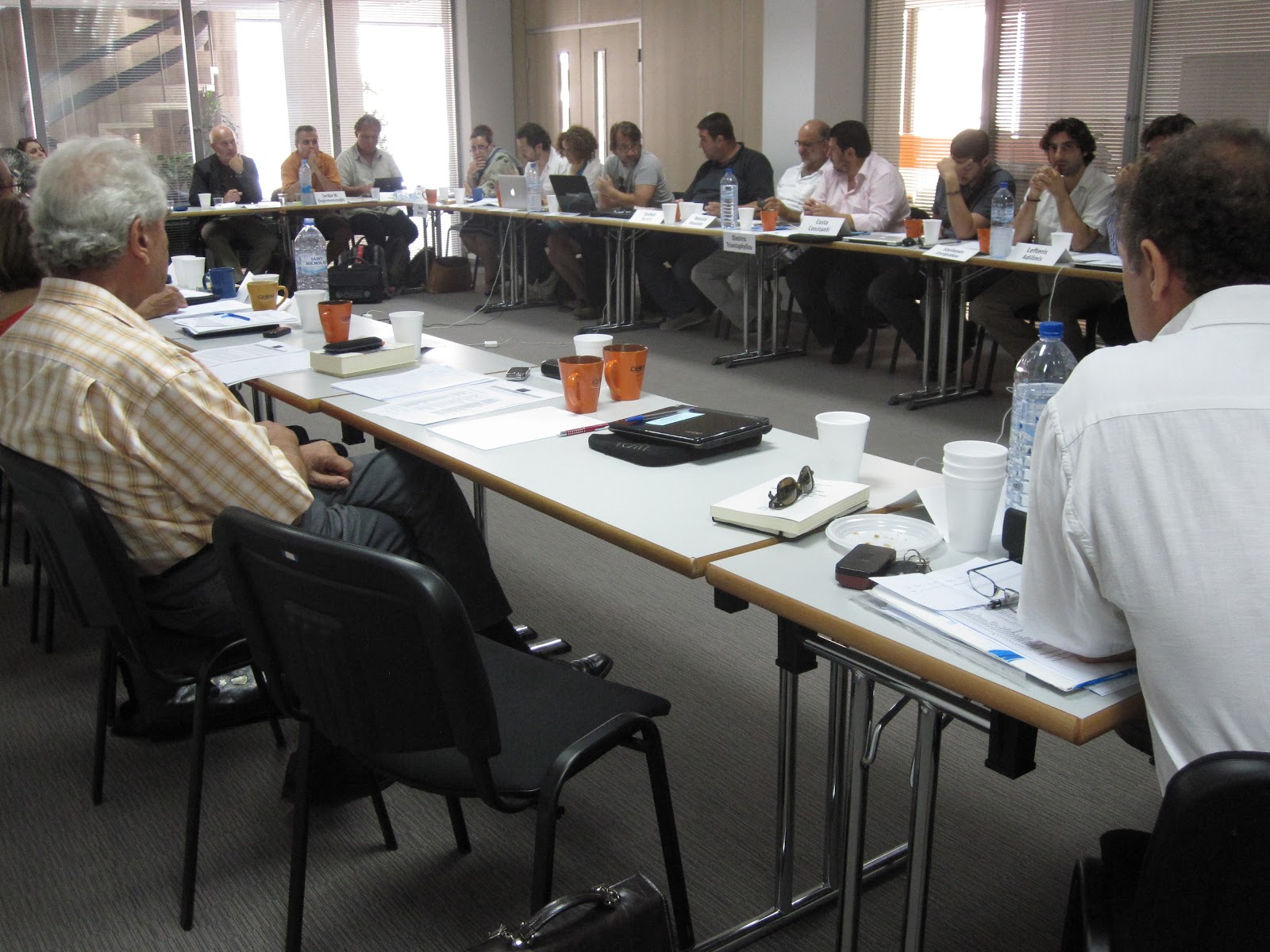
 Dr. Sylvia Tiryaki, together with her colleague
  Sylvia Tiryaki attended an international conference aiming to evaluate the EU-Turkey relations and the Turkish foreign policy. The event entitled “The Spanish Presidency: Expectations from Spain and Turkey” took place in Barcelona and was organized jointly by the