Turkey’s Broken Path to EU Membership | Turkish Review

Turkey’s Broken Path to EU Membership | Turkish Review

Dr. Sylvia Tiryaki wrote an article for Turkish Review’s
October-December 2011 edition with the title of “Turkey’s broken path to
EU membership.” The article argues the following: “As the oil and gas exploration commences off the East Mediterranean island of Cyprus, Turkey’s foundering EU negotiators are again likely to come under the spotlight, despite a lack of interest in the issue.” The article is an examination of the issues faced by Turkey on the road to EU membership, the waning importance of the European bloc in the country’s future and the possible impact of potential hydrocarbon reserves.


 To read the whole article online, please visit the website of its original source here.
KKTC’nin Posta Kodu: Mersin 10 Ya Da Ekonomik Bağımsızlığın Anlamı | TÜSİAD Görüş Dergisi

KKTC’nin Posta Kodu: Mersin 10 Ya Da Ekonomik Bağımsızlığın Anlamı | TÜSİAD Görüş Dergisi

Çok değil bir yıl öncesine kadar, Türkiye’deki gazetelerde Kıbrıs hakkında birşey yazmak o makalenin okunma ihtimalini azaltacağı anlamına geliyordu. Editörler yazıyı yine de başardı belki, ama okunma oranlarının düşme riskini de göze almış olurlardı. Okuyucu da, gazeteci de Kıbrıs sorunundan hoşlanmazdı. Klişelerin arasına sıkışmış olan Kıbrıs sorunu en popüler konular arasında değildi. Bir sohbette Kıbrıs konusunu açtığınızda da verilecek tepkiler muhtemel tepkiler “Kıbrıs’tan hala sıkılmadın mı? Hala orasıyla mı uğraşıyorsun? Artık bırak, orada birşeyin değişeceği yok” olurdu. İhtilafin “olaysızlığına” dair görüşler sadece Kıbrıslı Türk ve Rumların arasındaki görüşmelere değil, Birleşmiş Milletler ve Avrupa Birliği’nin hiçbir şey yapmayışına da gönderme yapardı.


Makalenin devamını okumak için buraya tıklayınız (s. 57-59).

Heybeliada Talks: Two Years of Public Diplomacy on Cyprus

Heybeliada Talks: Two Years of Public Diplomacy on Cyprus

Since July 2008, Global Political Trends Center (GPoT) has been bringing together opinion leaders from North and South Cyprus, as well as Greece and Turkey, under the banner of the “Heybeliada Talks” to discuss issues pertaining to the solution of the Cyprus problem. The meetings, usually closed to journalists and conducted under Chatham House rules, provided the participants with a trusting environment to frankly debate contested issues, usually in parallel with the official negotiations. GPoT Center is by principle committed to the ideals of dialogue, non-violence, reconciliation and consensus for both this process and the eventual solution. This publication is a combination of the work of the GPoT staff and the participants of the nine rounds of the Heybeliada Talks held to date. Our main objective in preparing this book has been to consolidate the ideas put forth during the past years by Greek Cypriots and Turkish Cypriots, and to have them be accessible to a wider public of policy-makers, media and academics, as well as governments and political figures.

For an electronic copy (in English) please click here.

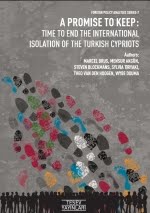
A Promise to Keep: Time to End the International Isolation of the Turkish Cypriots

A Promise to Keep: Time to End the International Isolation of the Turkish Cypriots

Sylvia Tiryaki together with other five researchers from different disciplines and background wrote a book demonstrating that the isolationist policies imposed on Turkish Cypriots have no legal justifications. The book entitled “A Promise to Keep: Time to End the International Isolation of the Turkish Cypriots” was published by TESEV in 2008 and is available in English here.

Summary in Turkish

Annan Planı’nın 24 Nisan 2004 tarihinde Kıbrıs Rum kesimi tarafından reddedilmesinden sonra Kıbrıs’ta çözüme yönelik pek fazla bir gelişme olmamıştır. Çok kapsamlı çözüme yönelik bir gelişme sağlanamamış olsa da, Kıbrıs Cumhuriyeti’nin Avrupa Birliği’ne (AB) katılım süreci aynı şekilde devam etmiş ve bu üyeliğin AB’nin kendisi için oluşturacağı hukuki problemlere rağmen Kıbrıs Cumhuriyeti AB üyelik sürecini tamamlamıştır.

Bu çalışmanın yazılmasındaki başlıca amaç, Kıbrıslı Türklere senelerdir uygulanan uluslararası izolasyonların hukuki dayanaklarının geçerliliğini değerlendirmek ve Kuzey Kıbrıs Türk Cumhuriyeti’nin (KKTC) resmi olarak tanınmasına gerek kalmadan da izolasyonların kaldırılabileceğini göstermekti. Yazarlara göre, adanın kuzeyinde yaşayan Kıbrıslı Türklere uygulanan izolasyon politikalarının hiçbir hukuki dayanağı yoktur ve dolayısıyla bir an önce kaldırılmalıdırlar. Kıbrıs sorunu, Kıbrıs Cumhuriyeti’nin AB üyeliğinden sonra daha da siyasi bir hal alarak, KKTC’nin tanınması ile ilgili dile getirilen endişelerin ötesine gitmiştir. Fakat, bu çalışma izolasyonların sadece ekonomik ve politik etkilerini değil, insani boyutunu da gün ışığına çıkarmak üzere hazırlanmıştır.

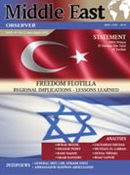
Freedom Flotilla: Before and Aftermath

Freedom Flotilla: Before and Aftermath

Sylvia Tiryaki’s analysis on the Turkish-Israeli relations entitled “Freedom Flotilla: Before and Aftermath” was published in the issue 3, volume 1 of the Middle East Observer (MEO), a journal featuring articles on Middle East and Persian Gulf Unit, published by Athens-based Institute for Security and Defence Analysis. Check out her analysis here.

Intro

After more than sixty one years, the Israeli – Turkish relations have entered a phase that some observers are prone to see as the final one. It is the least to say that, had such an assumption been correct, it would not have been the happiest end; and certainly not a desirable one.

A Forgotten Promise: Ending the Isolation of Turkish Cypriots

A Forgotten Promise: Ending the Isolation of Turkish Cypriots

Sylvia Tiryaki and Mensur Akgün wrote an article about the isolation of the Turkish Cypriots. The analysis is available in Insight Turkey, Vol. 12, No. 1/2010. You can read the online version here.

Abstract

Despite repeated calls and promises, Turkish Cypriots live in economic, political and humanitarian isolation. This paper tries to address one aspect of it and elaborates on the legal basis of these isolationist practices imposed on one side of the island. It challenges the international legal validity of the de facto sanctions. Furthermore, it claims that lifting economic isolation will also serve as a confidence building tool between Greek and Turkish Cypriots as well as between Turkey and the Republic of Cyprus represented by the Greek Cypriots since such an act will lead to Turkey’s reciprocation and the normalization of relations with the Republic of Cyprus. It also argues that neither the UN, nor the EU has ever imposed any sanctions on Turkish Cypriots and the policy of isolation, as such, has only been practiced by the Greek Cypriots and the Greeks.is paper intends to clarify the distinction between sanctions and non-recognition. It also highlights the promises made by the EU to the Turkish Cypriots, in particular, the one made on April 26, 2004, when the Council of the EU proclaimed its commitment to end the isolation of the Turkish Cypriot community.

Finding Common Grounds: Rediscovering the Common Narrative of Turkey and Europe

Finding Common Grounds: Rediscovering the Common Narrative of Turkey and Europe

“Finding Common Grounds: Rediscovering the Common Narrative of Turkey and Europe” is the result of the combined efforts of 9 authors who came together to discuss the possible ways forward for Turkey’s EU accession process. As an indication of the content of the book, the authors are likened to “a very atypical group of passengers who found themselves in the same carriage of a train that was speeding towards a point where the track might end. Some of them were searching for a way to stop the train and bring it back to a junction from where they could travel more safely to the desired destination. Others were convinced that there was no way to stop it and they were rather trying to see how to build a new track so that the train could carry on”. Published in 2009 with support from the German Marshall Fund, Friedrich Ebert Stiftung in Bratislava as well as the Open Society Foundation in Bratislava and published by the Research Center of the Slovak Foreign Policy Association, this book  has positively contributed to the discourse regarding Turkey’s EU accession since that time. An electronic copy (in English) of the book can be accessed here.

The Following is an Excerpt from the Book Detailing the Chapter’s Contents

“The collection starts with contribution of Hurriyet Daily News
editor-in-chief David Judson, who in his essay looks on what media
can and cannot do in breaking the obvious communication divide
between the EU and Turkey. Then we follow with four articles looking at EU decision-making vis-à-vis Turkey. Adam Szymański writes about the Eu’s fears vis-à-vis Turkish membership and suggests some policies the EU had better employ now. David Král looks at what could be expected from the Czech EU presidency and Deniz Bingol Mcdonald and Peter Balazs analyze the roles of conditionality and public opinion in enlargement. Ceren Ak, Sylvia Tiryaki and Mensur Akgün evaluate the union’s approach after last year’s evaluation report. We close the volume by another reflection by Lucia Najslova– an essay on “talking Turkey” in Slovakia or what it takes to mainstream a seemingly marginal topic.”

EU Accession Prospects for Turkey and Ukraine: Debates in New Member States

EU Accession Prospects for Turkey and Ukraine: Debates in New Member States

This publication, published in 2006, provides insight into the terms of the debates on further EU enlargement in several new Member States as well as in Turkey and Ukraine. The results of these debates deserve more attention in the old Member States since they testify to the pool of optimism and openness on both sides of the border of the enlarged EU. Regardless of the twists and turns that the EU integration process is taking at the moment, the vision of enlarging Europe remains attractive to the citizens of the countries most directly concerned, who are still acutely aware of the costs of fragmentation and isolation. It is the hope of the team of authors that this broad perspective will not be lost in future debates on the costs of further enlargement and on the EU’s ‘absorption capacity’.

Sylvia Tiryaki wrote the chapter entitled “The Debate on the EU Membership Prospects of Turkey”.

To access the electronic copy click here.

Quo Vadis Cyprus

Quo Vadis Cyprus

In 2005 Mensur Akgün, Ayla Gürel, Mete Hatay, and Sylvia Tiryaki authored “Quo Vadis Cyprus” published by TESEV. An electronic copy (in English) can be accessed here.

The Following is an Excerpt from the Preface

“Cyprus is one of the key issues in Turkish Foreign Policy today, probably even more so than it has ever been. A peaceful settlement that optimizes the needs and minimizes the concerns of both the Turkish Cypriot and Greek Cypriot sides is of utmost significance and urgency. A settlement is needed not only to enable Turkey to continue its path towards European accession, but also in order to establish and perpetuate a peaceful coexistence between the two communities on the island.”